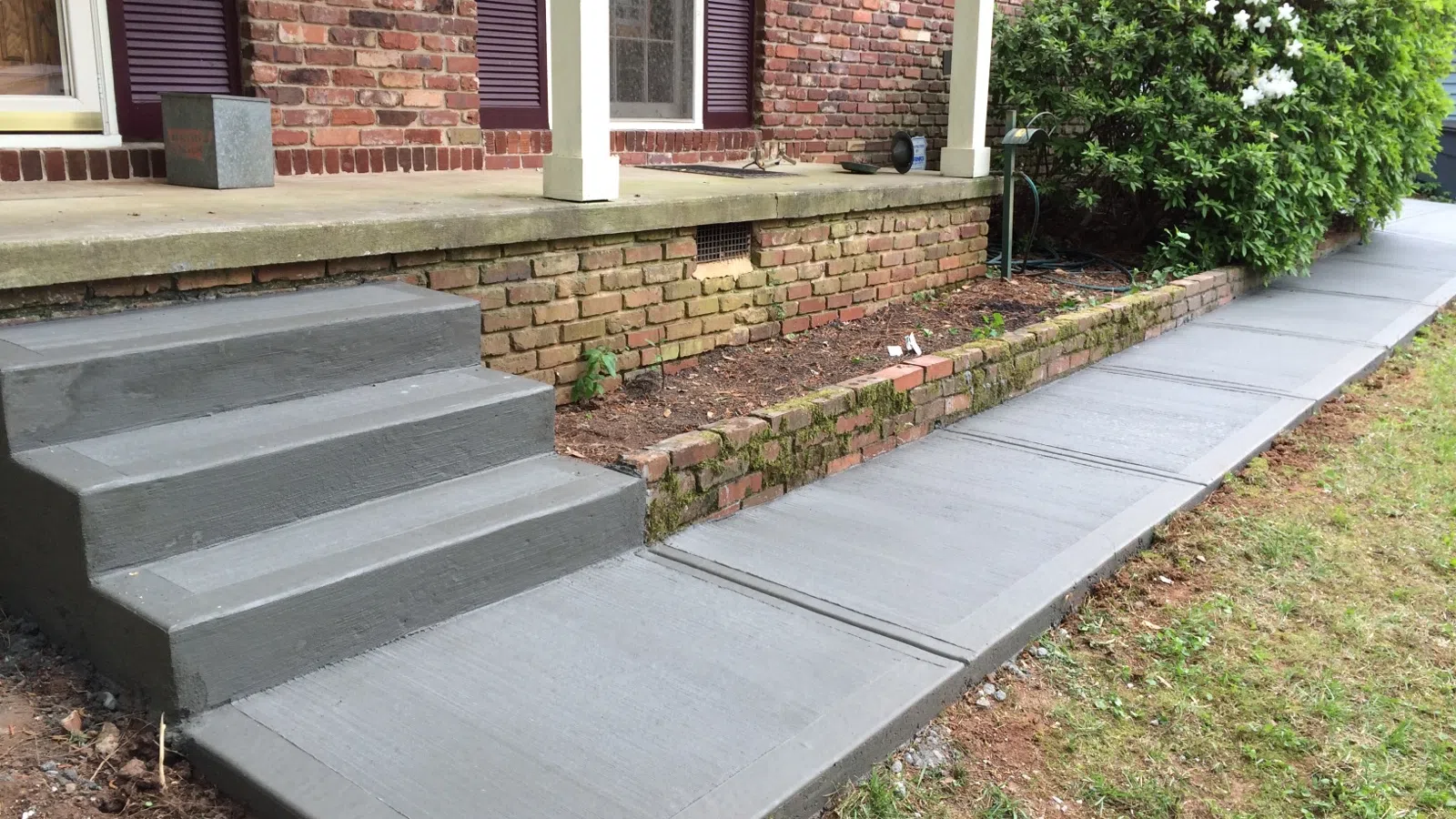
How to Repair Cracked or Chipped Concrete Steps
Concrete Step Repair
All you need to know

Small chips and hairline cracks can usually be patched with a concrete repair mortar. Cracks that run through a full step, multiple crumbling edges, or steps that feel unstable underfoot are safety hazards that call for professional repair.
Steps are the one part of a home's concrete that gets used, without exception, every single day. That's exactly why we treat step damage differently from a crack out in the middle of a driveway, the margin for "wait and see" is a lot smaller.

What Step Damage Actually Feels Like Underfoot
Most people notice step damage the same way: not by looking down, but by feeling something off while walking. A slight give or wobble at the top step that wasn't there before. A front edge that's started to crumble enough that you can feel loose grit under your shoe. A step that used to feel perfectly flat now catching your toe just slightly on the way up. None of these are dramatic in isolation, but they're exactly the sensations that precede a fall.
Why Steps Crack and Chip in the First Place
Steps take more concentrated wear than nearly any other concrete feature on a property: the front edge (the nosing) absorbs the brunt of every footstep, and the whole structure sits on its own small footing that's just as exposed to Georgia's shifting clay soil as a driveway or foundation, often more so, since steps are frequently not tied into the same footing as an attached porch.
Decision Framework
Chipped front edge, no wobble, no crack running through the step: DIY-friendly patch with repair mortar.
Crack running the width of a step, one side slightly higher: the footing has likely shifted; this needs a professional look, not a surface patch.
Any wobble, give, or movement when you step on it: stop using that step if possible and get it evaluated. This is the one situation on this list we'd call urgent rather than "get to it this month."
Damage near where the steps meet a porch or deck: the connection point matters as much as the steps themselves; have both inspected together.
DIY Repair for Minor Damage
For chipped nosing and hairline cracks, a concrete repair mortar shaped to match the step's profile does the job. Clean thoroughly, apply a bonding agent if the product calls for one, build up the patch in thin layers for deeper chips, and let it cure fully before regular use. See restoring cracks in concrete for general technique.
What We Look for on a Step Inspection
We physically test each step, standing on the edge and the center, not just looking at it, since a step can look fine and still have movement you'd only catch by weight-testing it. We also check whether damage is isolated to one step or spread across several, since that pattern tells us whether we're looking at localized wear or a footing problem affecting the whole structure.
Common Mistakes We See
Patching a chipped edge repeatedly without ever asking why that same spot keeps crumbling, usually a sign of water getting into the concrete at that exact point every time it rains. And treating a wobbly step as a "someday" project, when it's genuinely one of the more common sources of fall injuries around a home entrance. Related reading: how to best fix trip hazards on concrete.