What Causes Driveway Cracking in Atlanta?
How to Fix a Sunken Concrete Sidewalk
All You Need To Know

Atlanta driveways crack most often because of expansive red clay soil, extreme summer heat, poor drainage, tree root intrusion, and inadequate reinforcement or base preparation during the original installation. Most cracking is preventable with the right build.
We get some version of "why does this keep cracking" almost every week, usually from a homeowner who assumes their driveway must have been poured wrong. Sometimes that's true. More often, it's Georgia doing what Georgia does to concrete. Here's what's actually working against your driveway, ranked roughly by how often we see each one.

What We See Most Often on Cracked-Driveway Calls
If we had to bet on the cause before even seeing a driveway, our money would be on the soil. Atlanta sits on expansive red clay that swells noticeably when saturated and pulls back hard as it dries out. That push-pull cycle, repeated every wet season for years, is behind the majority of the driveway cracks we get called out for. It's rarely the concrete itself failing; it's the ground underneath refusing to sit still.
Georgia's Red Clay, in Practical Terms
You can actually see this soil at work if you know what to look for: deep, visible cracks in exposed clay soil after a dry stretch, or standing water that takes noticeably longer to soak in after rain than it would in sandier soil. That same swelling and shrinking is happening underneath your driveway, just hidden from view. Over years of cycles, it's the single biggest reason Atlanta driveways crack earlier than driveways built on more stable soil elsewhere in the country.
Heat and Humidity Cycles
Atlanta summers regularly push past 90°F with heavy humidity, and that thermal cycling adds ongoing stress to a slab on top of what the soil is already doing. We cover this in how heat and humidity affect concrete.
Tree Roots
In older, tree-lined neighborhoods around Atlanta, we regularly find cracks tracing directly back to a root system that grew toward the driveway looking for water, sometimes from a tree 20 or more feet away. If a crack runs in a fairly straight line toward a large tree, that's usually not a coincidence.
Poor Subgrade Prep or Missing Reinforcement
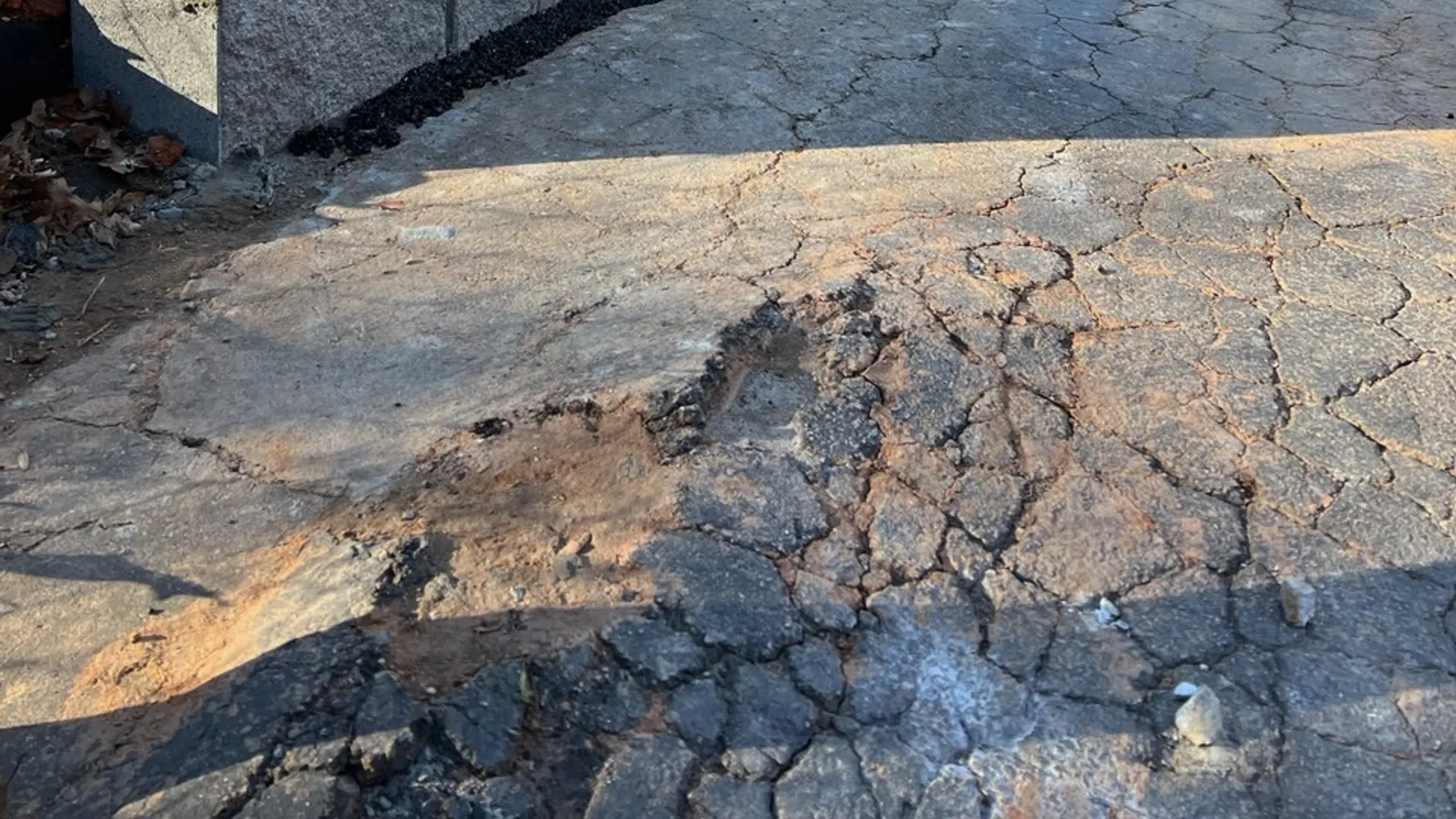
This is the one we can usually spot from the crack pattern alone. A driveway poured without a properly compacted gravel base or adequate rebar tends to crack in a scattered, seemingly random pattern rather than following clean lines, because there's nothing holding the slab together as the soil shifts beneath it. More on reinforcement in types of concrete reinforcement.
Heavy Vehicles and Water
Rounding out the list: vehicles heavier than the slab was designed for, and standing water saturating the soil beneath the driveway, which amplifies the clay soil problem described above. We cover proper grading in concrete driveway drainage.
Decision Framework: Is Your Cracking Normal or a Warning Sign?
- One thin, stable hairline crack: normal, keep an eye on it.
- Multiple cracks radiating from one point, or a crack that's visibly grown since last year: worth a professional look.
- Any crack with an offset you can feel: don't wait, see how to repair a cracked concrete driveway.
- Cracking concentrated in one specific area every time: likely a localized drainage or root issue, not a driveway-wide problem, and often cheaper to fix than you'd think.
How We Build to Work Around These Causes
Every driveway we build accounts for Georgia's clay from the start: proper base compaction, reinforcement sized to the soil conditions, and grading that moves water away rather than letting it sit. It's not a guarantee against every crack, nothing is, but it's the difference between a driveway that shows a hairline crack in year 20 versus year 3.