Stamped Concrete vs Pavers:
Cost & Longevity Comparison in Atlanta
If you're upgrading a patio, driveway, or pool deck in Atlanta, you've likely narrowed your choices down to two popular options: Stamped Concrete or Interlocking Pavers.
Both offer incredible curb appeal and can mimic the look of natural stone, slate, or brick. However, they perform very differently over time—especially when subjected to Georgia's unique soil and climate. Here is how they stack up.
Initial Cost Comparison
In the Atlanta market, budget is often the first consideration.
- Stamped Concrete: Typically has a lower upfront cost. Because it is a single-pour process, it is less labor-intensive and installs much faster. You can usually expect stamped concrete to be 15-30% less expensive than pavers.
- Pavers: These have a higher initial cost for both materials and labor. Every individual unit must be hand-set by a crew, which significantly increases the timeline and the price tag.
Installation & Soil Considerations
Atlanta is famous for its heavy red clay. This is a major factor in installation:
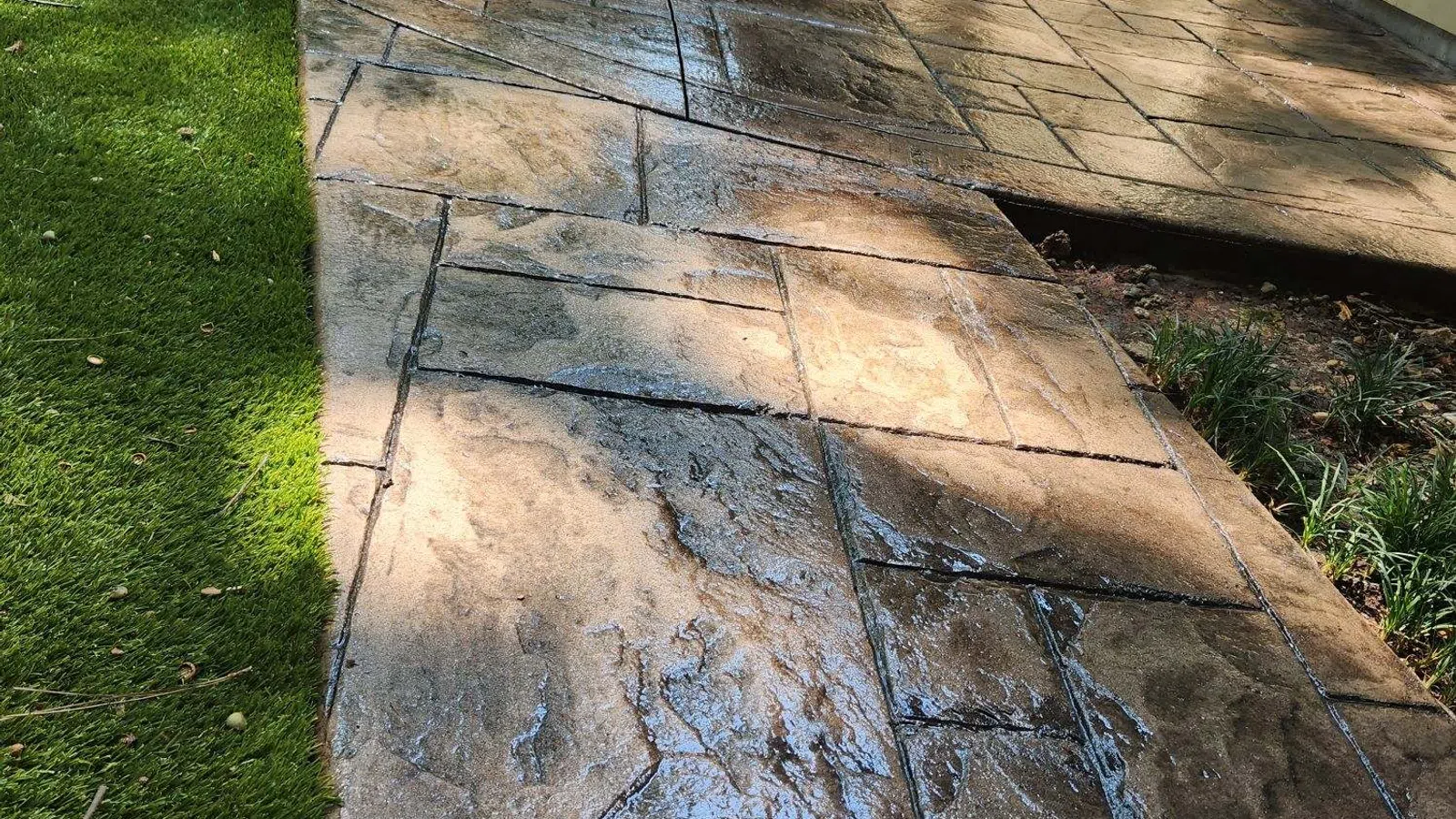
- Stamped Concrete: We pour one monolithic slab over a reinforced base. While all concrete is prone to minor hairline cracking, we use rebar and strategic control joints to manage that movement.
- Pavers: These sit on a sand-set base. Because pavers are modular, they are extremely sensitive to the "shrink and swell" of Georgia clay. If the base preparation isn't perfect, pavers can quickly become uneven, creating tripping hazards.
Maintenance Over Time
- Stamped Concrete: Maintenance is straightforward. You'll need to clean and reseal the surface every 2-3 years to keep the color vibrant and protect the finish.
- Pavers: Maintenance is more frequent. You have to deal with weed growth between the joints, "polymeric sand" washouts after heavy rainstorms, and individual units that may shift or "dip" over time, requiring them to be pulled up and re-leveled.
The "Atlanta Heat" Factor
One thing homeowners often forget is surface temperature. In a Georgia July, any outdoor surface gets hot. However, pavers (especially darker brick or stone) tend to hold thermal heat longer than concrete. Stamped concrete can be finished with lighter "cool-toned" release agents to help keep the surface a bit more walkable for bare feet or pets.
Slip Resistance & Safety
- Stamped Concrete: We can add a non-slip additive to the sealer. This creates a "gritty" texture that is invisible to the eye but provides excellent traction, which is vital for pool decks or sloped driveways.
- Pavers: While naturally textured, the joints between pavers can catch water, leading to algae growth in shaded areas. As we've discussed before, algae on concrete or stone becomes incredibly slippery when wet.
Repairability
- The Paver Advantage: If a pipe bursts underground, you can pull up pavers and put them back.
- The Concrete Advantage: While you can't "pull up" concrete, it is much easier to keep clean. You don't have to worry about a single heavy rainstorm washing away your joint sand and leaving your patio looking unfinished.
Longevity in the Georgia Climate
- Stamped Concrete: Can easily last 20+ years with proper sealing. It provides a seamless, high-end look that doesn't "age" as quickly as modular systems.
- Pavers: Can also last decades, but they often require a "refresh" every 5-7 years to fix shifting units or replace lost sand.
Which Is Better for Your Home?
There isn't a universal winner, but there is usually a better fit for your specific property.
Stamped Concrete is likely your best bet if:
- You want a high-end, seamless look for a lower price.
- You want a low-maintenance surface that won't grow weeds.
- You want a faster installation so you can use your backyard sooner.
Pavers might be the choice if:
- You prefer a traditional, modular "old world" brick look.
- You are okay with ongoing joint maintenance and weeding.