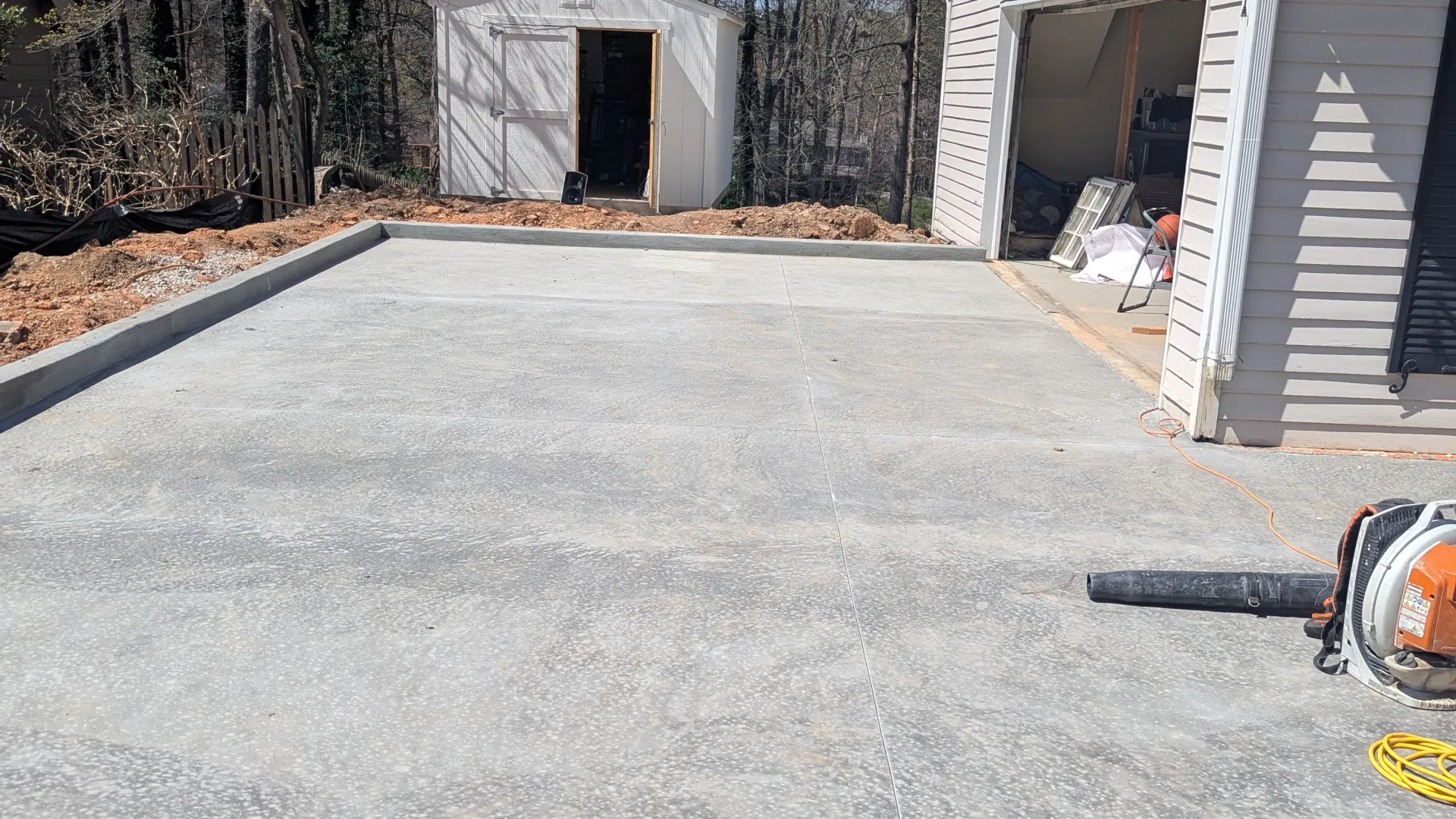
Concrete Driveway Drainage:
What to Know Before You Pour
Concrete Driveway Drainage
All you need to know

A concrete driveway should slope at roughly 1 to 2 percent grade away from your home and garage. In Atlanta, where clay soil already holds water, poor drainage planning is one of the leading causes of early driveway cracking and settling we see on inspections.
Drainage is the thing almost nobody asks us about upfront, and it's usually the first thing we look at when we're called out to a driveway that's cracking earlier than it should. Get the grading wrong at the pour, and you're setting up problems that won't show up for a year or two, by which point they're a lot more expensive to fix.

What We See Most Often on Drainage-Related Calls
The pattern repeats itself often enough that we can usually spot it before the homeowner finishes describing the problem: cracking concentrated near the low end of the driveway, a garage that smells faintly musty after heavy rain, or a dark, slightly sunken stripe of concrete near the street where water clearly sits the longest. None of these look dramatic on their own. Together, they almost always trace back to a slope that was never quite right, or a downspout dumping straight onto the slab instead of away from it.
What Pooling Water Actually Looks Like
Homeowners often describe their driveway as "draining fine" because it doesn't flood. But a driveway can have a real drainage problem without ever looking like a puddle. The tell is usually more subtle: a damp patch that's still visibly darker than the rest of the slab an hour or two after the rain stops, a thin film of algae or moss building up in one specific spot season after season, or grass along the edge of the driveway that's greener and lusher than the rest of the yard because it's getting extra runoff every time it rains. Any of these means water is lingering longer than it should.
Decision Framework: Do You Have a Drainage Problem?
If water is gone within 15-20 minutes of rain stopping: your grading is likely fine.
If water is still visibly standing an hour or more after rain: you likely have a low spot or inadequate slope that needs correcting.
If cracks are appearing specifically near where water tends to collect: the soil beneath that section is being repeatedly saturated, and it's worth having both the crack and the drainage evaluated together, not separately.
If water is flowing toward your garage or foundation at all: that's not a "keep an eye on it" situation, that needs to be corrected regardless of whether cracking has started yet.
Standard Slope and Grading
Most residential driveways are graded at a 1 to 2 percent slope, roughly 1/8 to 1/4 inch of drop per foot, angled away from the garage and foundation. It's a subtle enough grade that most people never notice it visually, which is exactly the point: a well-graded driveway shouldn't look sloped, it should just never hold water.
How We Approach Drainage on Every Pour
Before we ever set forms, we walk the property after a rain if we can, or ask the homeowner directly where water tends to collect. Grading gets designed around the answer, not the other way around. On sloped lots or ones with a history of pooling, we'll typically recommend a channel drain or French drain as part of the original scope rather than waiting to see if it becomes a problem, since retrofitting drainage after the concrete is down is far more disruptive than building it in from the start.
Fixing Drainage on an Existing Driveway
If you're dealing with an existing pooling problem, you're generally choosing between adding drainage features without repouring, or a resurfacing/replacement that corrects the slope at the source. Which one makes sense depends on how much the slab has already been affected. We cover that decision in resurfacing vs. replacement, and the cracking patterns drainage tends to cause in what causes driveway cracking in Atlanta.